Days 11 and 12 of my journey on the Portuguese Camino Coastal Route sees me completing my detour on the Spiritual Variant of the Portuguese Camino, with El Translatio – the maritime journey between Vilanova de Arousa to Pontesescures – one of few Camino legs that involves a boat ride. I rejoin the main Portuguese Camino routes at Pontesecures and finish my Camino journey on Day 12 of my pilgrimage at Santiago de Compostela.
This post includes affiliate links. If you make a purchase via one of these links, I may receive a small percentage at no extra cost to you.
Day 11: A Armentiera to Vilanova de Arousa (24.5km): stunning forest walk alongside a babbling brooke and then scorching, scorching sun
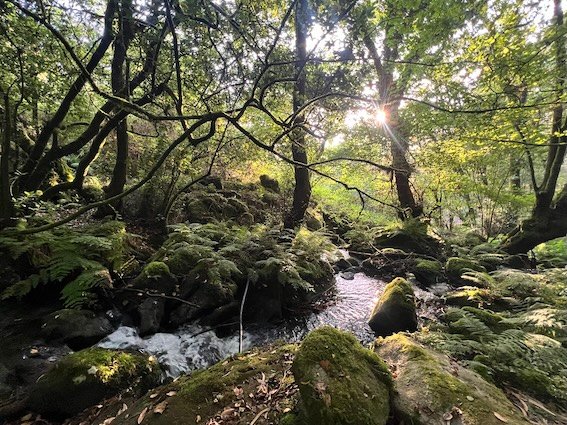
Day 11 on the Camino had two sides. The first half of the walk (roughly 12KM) was the most pleasant, beautiful and comfortable trails I have walked thus far through all my Camino experiences.
The path from A Armenteira immediately goes into a magical forest where you walk alongside a crystal clear stream. The sound of beautiful water accompanies you as you walk through the soft, lush forest that protects you from the sun. The trail is called the Ruta de Piedra y Agua (the walk of stone and water) and was once the source of various aquifer systems as well as water-powered milling systems in the area. Some of the machinery is still present on the trail.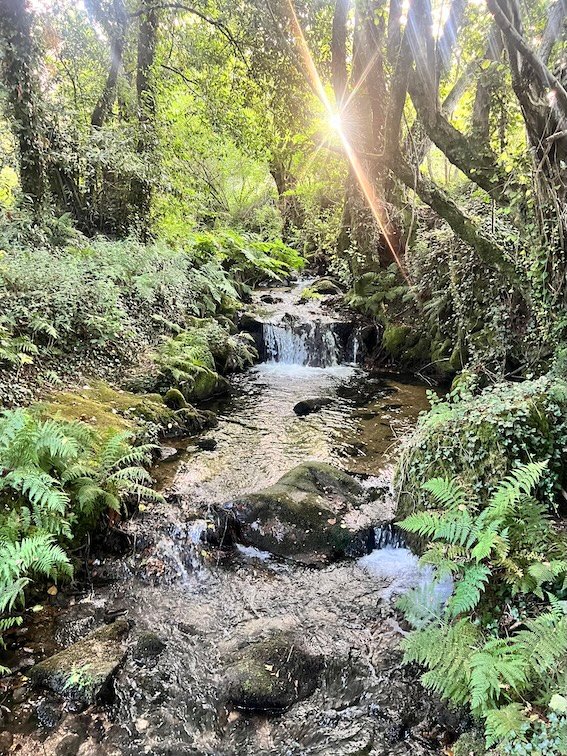
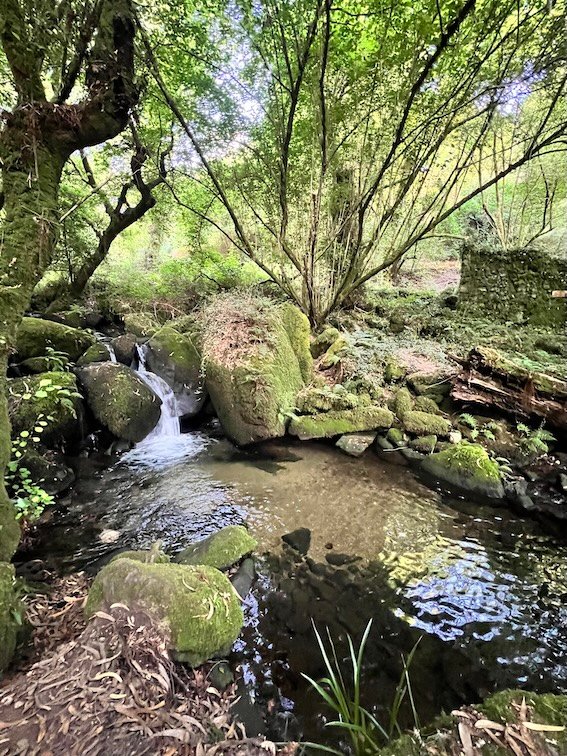
After about 3KM on the trail, you’ll come across a beautiful cafe called Gastrobar Ruta de Pedra e da Agua – a stunning woodland cafe that is absolutely worth a stop. The shop has delectable cakes, pastries and sandwiches, as well as clean washrooms to freshen up. The trail then continues along the path that will run alongside the Rego da Armenteira (Armenteira Creek), before the creek joins the Umia River near Barrantes.
The Camino continues along the Umia River until the town of Arnelas, which is where the woodland cover that characterized the 1st half of the day disappears, and the trail turns primarily into asphalt roadway. Unfortunately, pilgrims usually end up leaving the forest cover of the 1st half of the trail just as the afternoon sun is heating up, so the next half of the walk to Vilanova de Arousa on hot asphalt generally stands in stark contrast to the 1st half of the walk.
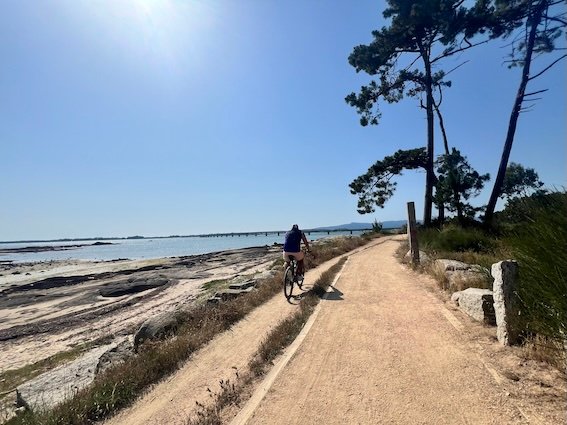
In the last few kilometers as you reach Vilanova de Arousa, you’ll pass a number of small beaches – they get larger as you approach the pedestrian bridge to the city. If you fancy a bit of beach time prior to your arrival in Vilanova de Arousa, these beaches would be the place to stop – as there are no beaches once you cross the pedestrian bridge to Vilanova de Arousa.
Vilanova de Arousa, is a small fishing town – the city dock area has a few seaside restaurants as well as the maritime port for boats taking pilgrims on “El Translatio” the final leg of the Spiritual Variant to Pontesecures.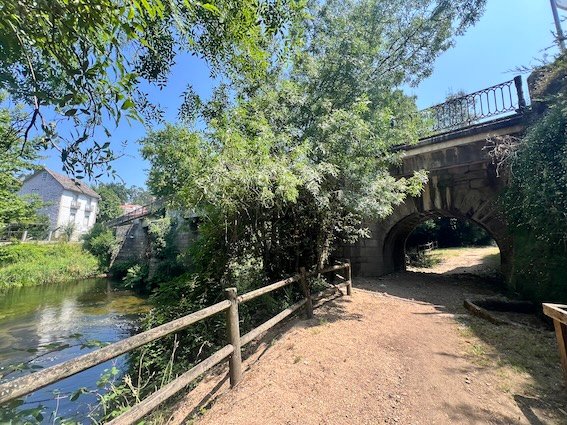
I was staying at a private Albergue called A Corticler about 400m away from the boat launch. The hostel is small but clean. Clear instructions on how to use the door access codes were sent to me the day of my arrival as well as e-checkin instructions so I could check myself in en-route to the hostel and relax once I arrived rather than have the check-in process there.
There were a number of other private albergues in Vilanova de Arousa – the benefit with private albergues being you don’t have to stick to the 10pm curfew – although if you’re taking the early boat to Pontesecures tomorrow you might well wish to be in bed before 10pm in any case.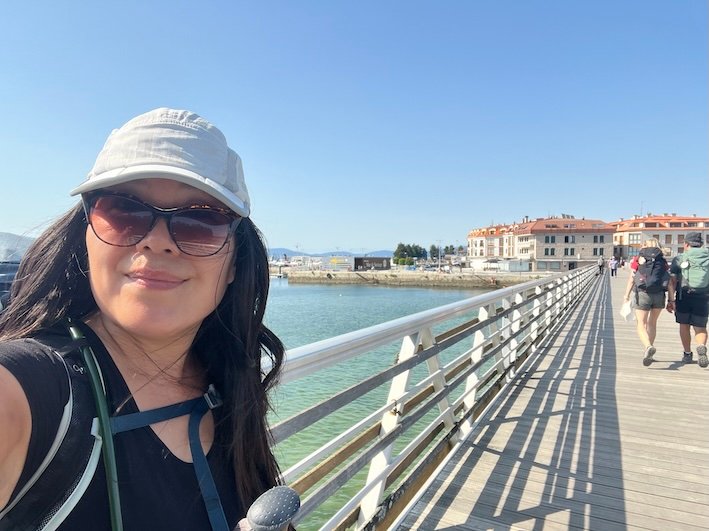
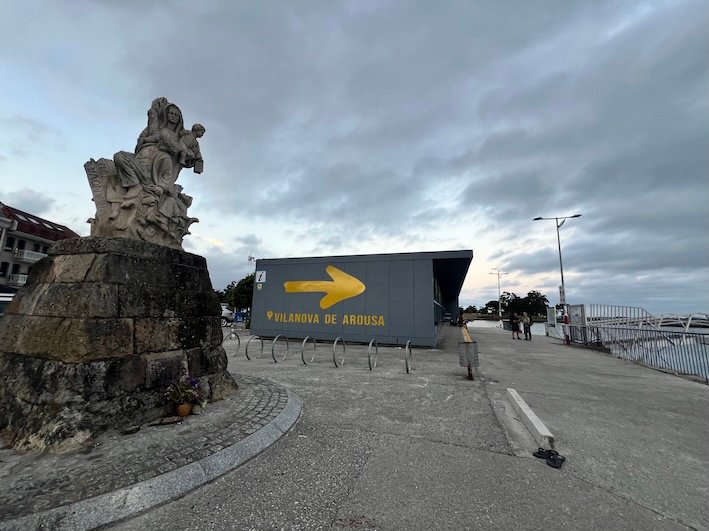
Day 12: Vilanova de Arousa to Santiago de Compostela: El Translatio, and the final walk to Santiago de Compostela (28KM)
Day 12 starts with the last stage of the Spiritual Variant: “El Translatio” a 28KM boat journey – which is said to be the same boat journey that brought the remains of the Apostle Saint James to Galicia. Today, it is the only officially recognized maritime stage of the Camino de Santiago. There are several sailings per day, but timings are confirmed the day before by the boat company depending on weather and tidal conditions. I booked the earliest boat from Vilanova de Arousa to Pontesescures which leaves at 7:30am.
My alarm went off at 6am, and when I dragged all my belongings into the hostel kitchen to pack – there were already 2 others there who were in the midst of packing and having breakfast. It was far too early for my comfort level but I needed to get the earliest boat as I still needed to walk 28KM from where the boat lands in Pontesescures, to Santiago de Compostela. I was out the door around 6:55am in order to catch the 7:30am boat (you need to be there 15 minutes ahead of departure for check-in).
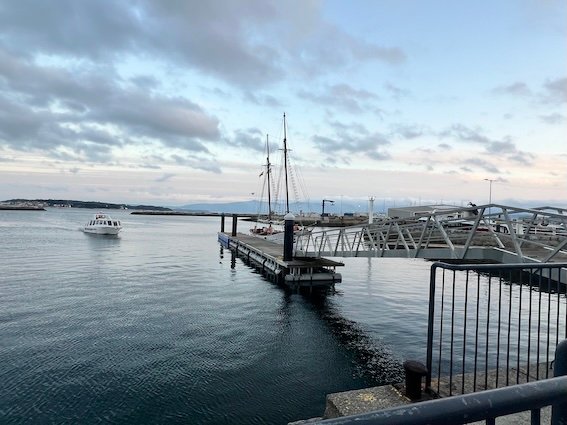
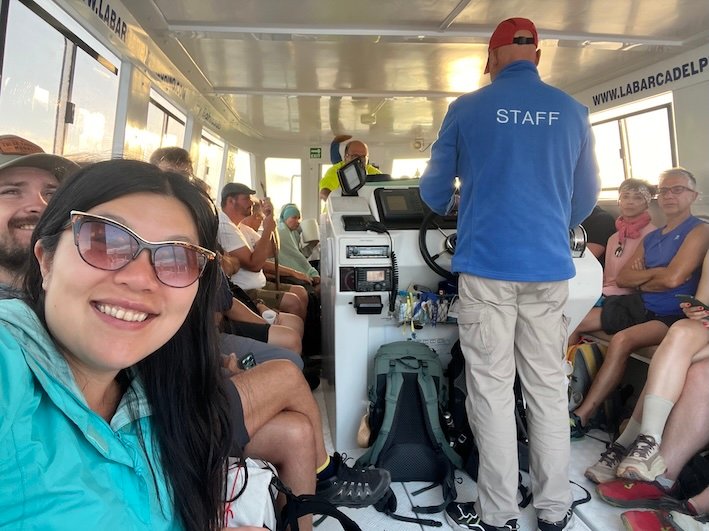
I would describe the boat we were on as something of a fancy covered speedboat. There was a cabin over the hull and we sat along both sides of the boat – with ample windows and the back door of the cabin was floor to ceiling glass so you could see out the back.
While the side windows could not be opened due to the spray of water from the movement of the boat; the back door remained open throughout the journey so you could peak outside to take photos if the water wasn’t too rough. Along the way, the captain stopped the boat to show us the mussel farms before we turned into the river estuary. We also stopped along some of the river landmarks such as crosses to commemorate the 12 disciples of Christ as well as the three crosses to commemorate the crucifixion.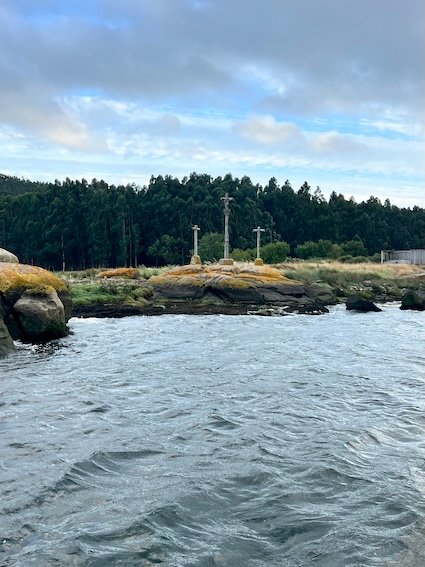
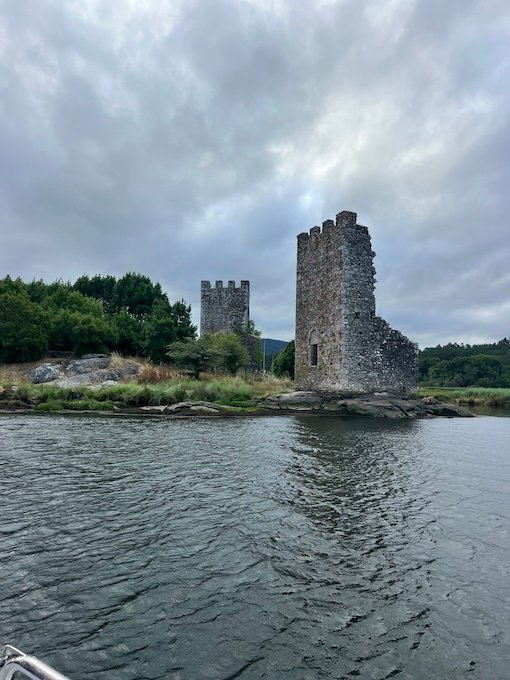
We journeyed by quaint riverside villages and finally arrived on Pontecesures around 1 hour 15 minutes after we left Villanova de Arousa. When we got off the boat, people quickly dispersed, but I ended up walking with an Englishwoman named Charlotte who was also planning to walk all the way to Santiago today.
By noon we had already walked nearly 15km, and we were both feeling like we needed a break and some food. Charlotte found a restaurant – Casa Touceda – with excellent ratings on Google. It was located on a few minute detour from the Camino near the town of Rua de Francos. We decided to go for it – as most restaurants right on the Camino tended to have poor reviews.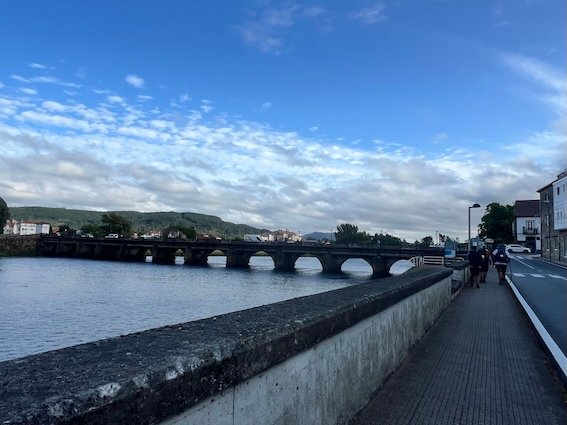
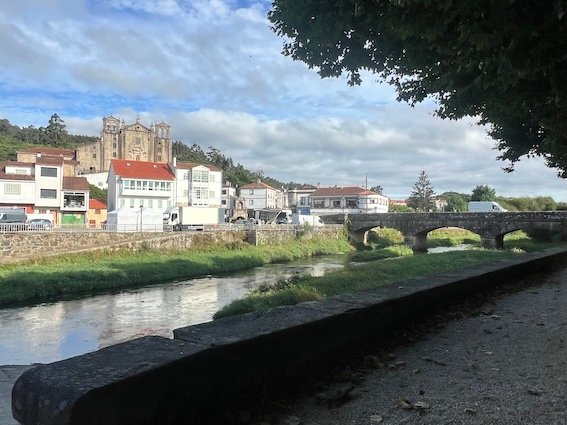
After lunch we promptly got back on the road, while we were making excellent time, we still had 13KM to travel, and we both had to get to Santiago before 7pm to make check in for our accommodations. We had a little celebration as we reached the first single digit marker on the Camino – less than 10KM to go now – but not over yet. Santiago de Compostela is located in a hilly area, so there were going to be some ups and downs before we could celebrate in front of the Cathedral.
I warned Charlotte that the approach into Santiago de Compostela was not particularly pretty – at least from my recollection on the French Route. The approach from the south on the Portuguese route was even worse.
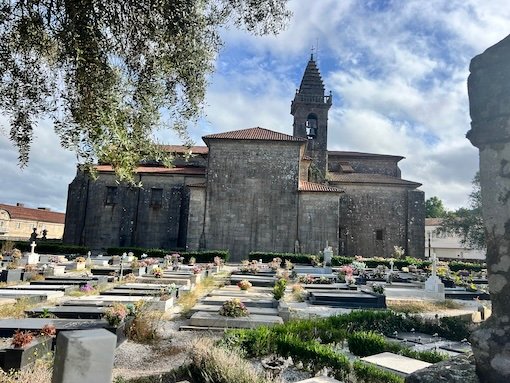
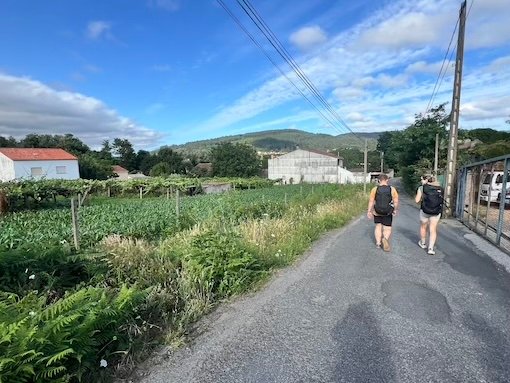
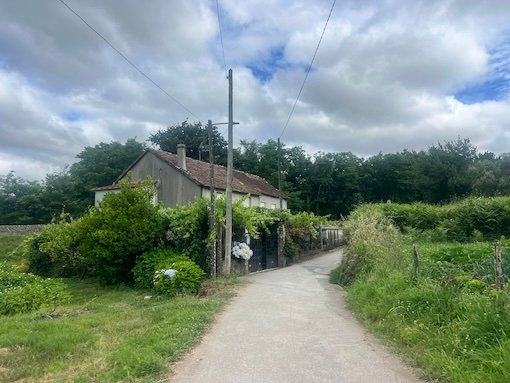
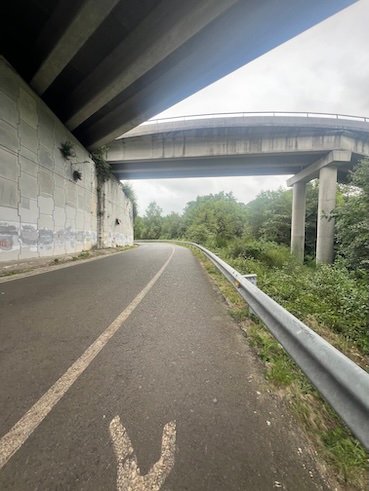
At various points we were on the side of a highway with overpasses criss-crossing the skies with barely a shoulder to protect us (I would strongly advise against walking this section in the dark). Definitely not spirit boosting as we walked some of those last kilometers. Finally, we were at the city limits. We were walking up some commercial/residential areas, which eventually led into the city center where the Cathedral is located.
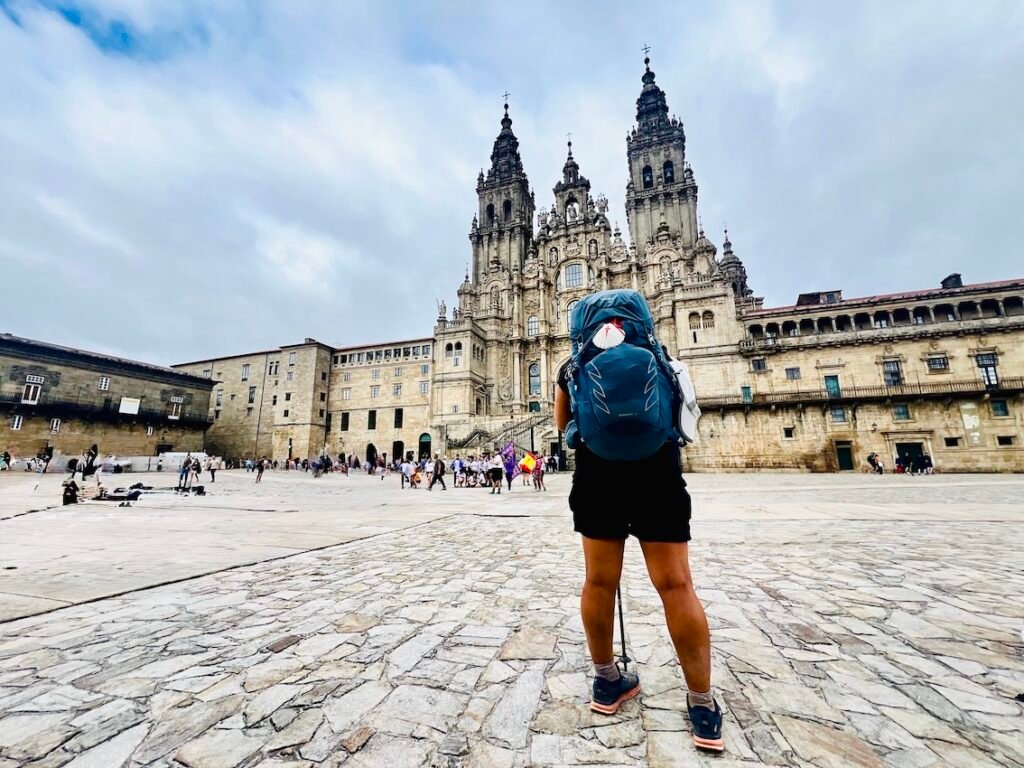
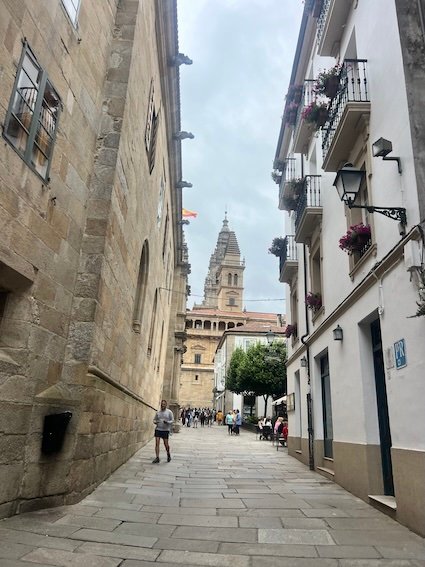
The last few hundred meters passed quickly as adrenaline started to pump as we got closer to the Cathedral. When we finally arrived at the finish in front of the Cathedral, Charlotte and I shared a celebratory hug and took our photos in front of the Cathedral before heading to a nearby bar for some celebratory Sangrias. The Sangrias definitely hit the spot and we made a plan to meet up after we checked into our accommodations and showered later that night to attend the 7:30pm Pilgrim Mass.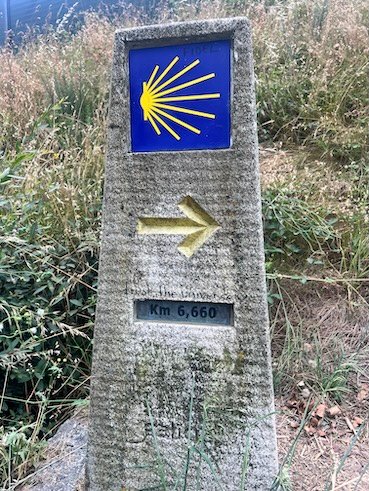
I had booked the Casa Celantes-Barbantes just 3 minute walk from the Cathedrale Square. The property is actually on the Portuguese route and we had passed it just as we headed into the square to complete our Caminos. I was very pleased with Casa Celantes-Barbantes. The property was not only exceptionally well located, but it was also very clean, and economical.
After a quick shower in my hotel room, I went to the Pilgrims’ Reception office to get my Compostela certificate. Things have changed quite a bit since I got my Compostela certificate in 2022. Now there are pre-registration kiosks where you input all your biographical information as well as your route information, start and end dates, which then spits you out a receipt with a QR code. You then wait for your number to be called like at the DMV. You then approach one of about 7 numbered kiosks with your QR code slip and your credential.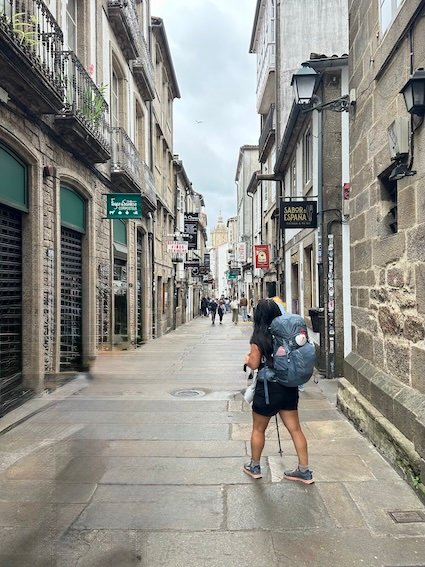
Once I got my Compostela certificate (the whole process took about 15 minutes) as there are no lineups late into the day; I headed back to my hotel room to drop the certificate off and freshen up before heading off to the 7:30pm Pilgrims’ mass.
Helpful hint: try to get to the mass 30 minutes before it starts in order to ensure you can get a seat.
I got there about 15 minutes ahead of the start, and had to make do with a makeshift seat on a pillar.
– Charlotte and I managed to find each other and thankfully there was enough space on my little spot on a pillar for us both to sit down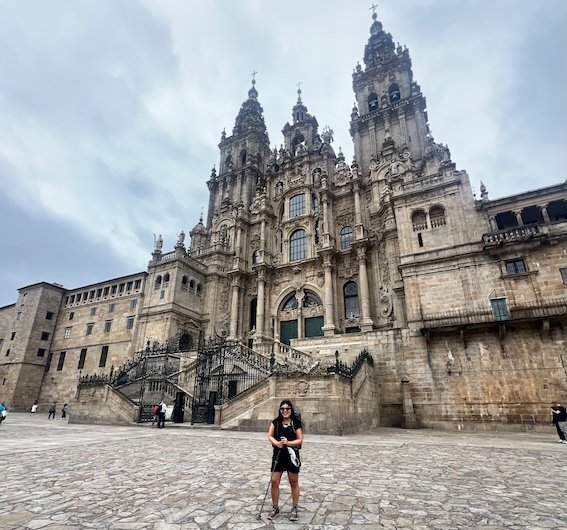
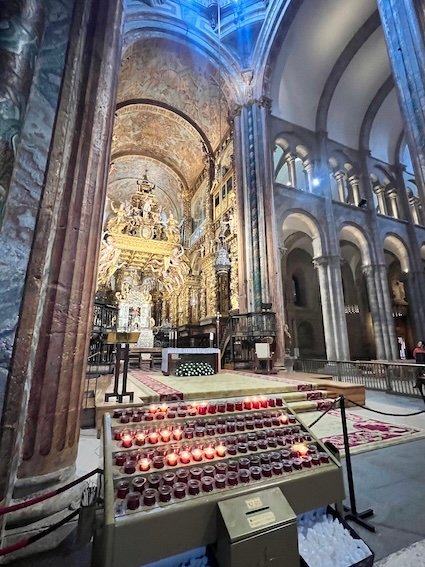
All mass services in the Cathedral are in Spanish – but they do hold services in other languages like English, French and German in the chapel near the Pilgrim Welcome Centre. All the standing up and sitting down was so hard on the feet during the mass. We were very lucky as this was one of the services where they used the Botafumiero – thank you to whichever group had paid the 350 Euro for it to be used during the service.
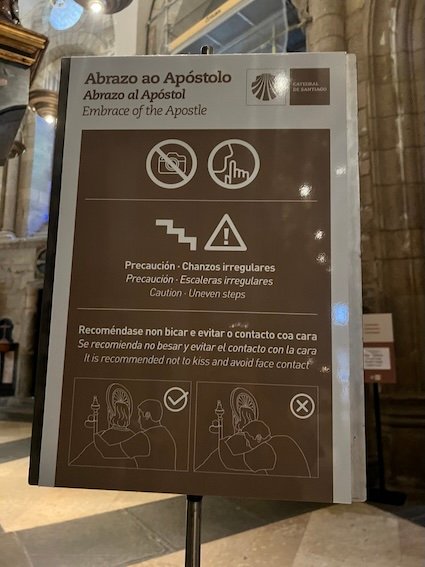
After the service I could already see a small lineup starting to form to view the shrine to the Apostle’s remains, so Charlotte and I b-lined over to queue up before the lines got too big. Once we viewed the shrine, the line-up actually naturally continues for the one that goes up to hug the statue of the Apostle. This was new to me, as in 2022 (I suppose with the world just coming out of the Pandemic) it was still not possible for people to hug the statue.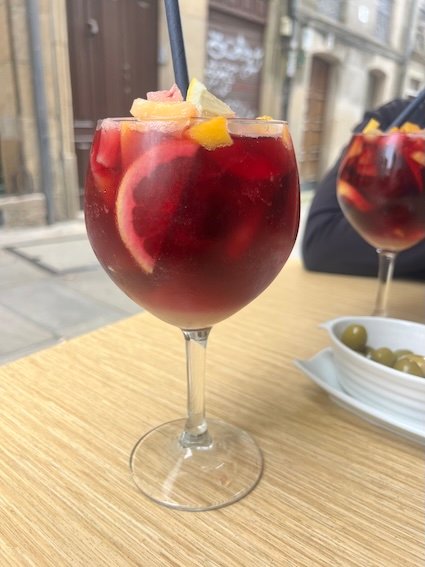
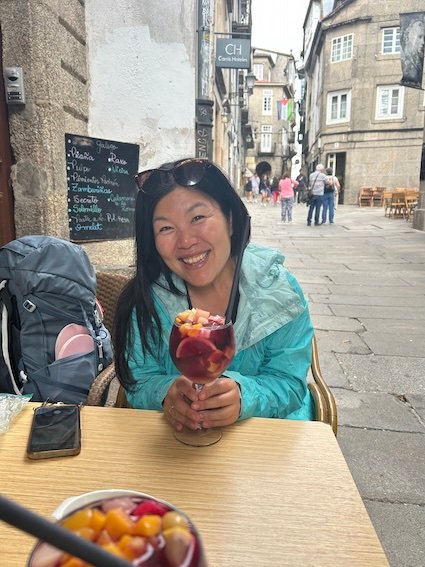
After Mass we headed into the city in search of dinner. Charlotte had already done some research on good restaurants, and we settled on Bar La Tita – a very popular and well-reviewed Tapas Bar just a few steps from the Cathedral. They’re famous for their tortilla (Spanish egg and potato flan). You can order as a portion, or they’ll actually serve you a good portion of it as a tapa for free if you just order a drink.
They had all the good stuff on the menu like Zamborinas, Calamari, Octopus, and other Spanish staples like Jamon serrano, sandwiches, salads and soups. Be aware that this place is super popular so be prepared to put your name on a list and wait about 15 – 20 minutes for a table.
Charlotte and I made it until the respectable hour of 11pm before we parted ways after dinner and headed back to our respective accommodations. I thought my energy levels were high for the day I just had, but quickly collapsed into slumber as soon as my head hit the pillow. Tomorrow, I’ll take the bus to Porto where I’ll spend 3 more days before heading home.
Hopeful hint: definitely pre-book your transportation out of Santiago de Compostela at least a few days/weeks in advance. Prices often double for day of travel and some routes and timing will be sold out. I used Omio to make my bookings out of Santiago de Compostela – e-tickets are issued right away, so you can head straight to the bus station with just your mobile ticket.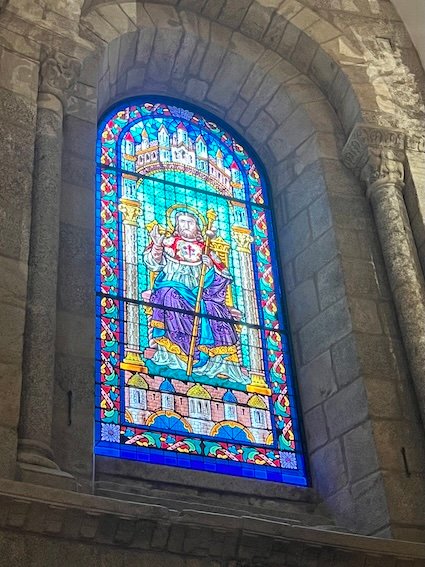
Final Thoughts on the Portuguese Camino Coastal Route – Senda Litoral:
Overall, my 328KM journey on the Portuguese Camino Coastal Route Senda Litoral – with the detour onto the Spiritual Variant was an immensely enjoyable experience. The coastal region of Portugal and Spain that the Camino on the Senda Litoral is absolutely stunning, and made for a memorable Camino experience that contrasted greatly with my first Camino on the French Route. I can honestly say that for my second Camino I actually enjoyed the journey more than I enjoyed the destination.
Perhaps because the journey was so much shorter this time around than walking from St. Jean Pied-de-Porte to Santiago de Compostela and then onwards to Finisterre; but walking into to Santiago de Compostela this time around felt somewhat anticlimactic this second time around. The Camino has become a lot more commercialized since the first time I walked it just a few years ago and Santiago de Compostela has certainly not been spared. I still love the Camino experience, but next time, I might walk a longer route – even if it means doing it in sections over the course of several years and perhaps that magic, awe, and wonder of seeing the Cathedral after a truly long journey will return to me once again.